






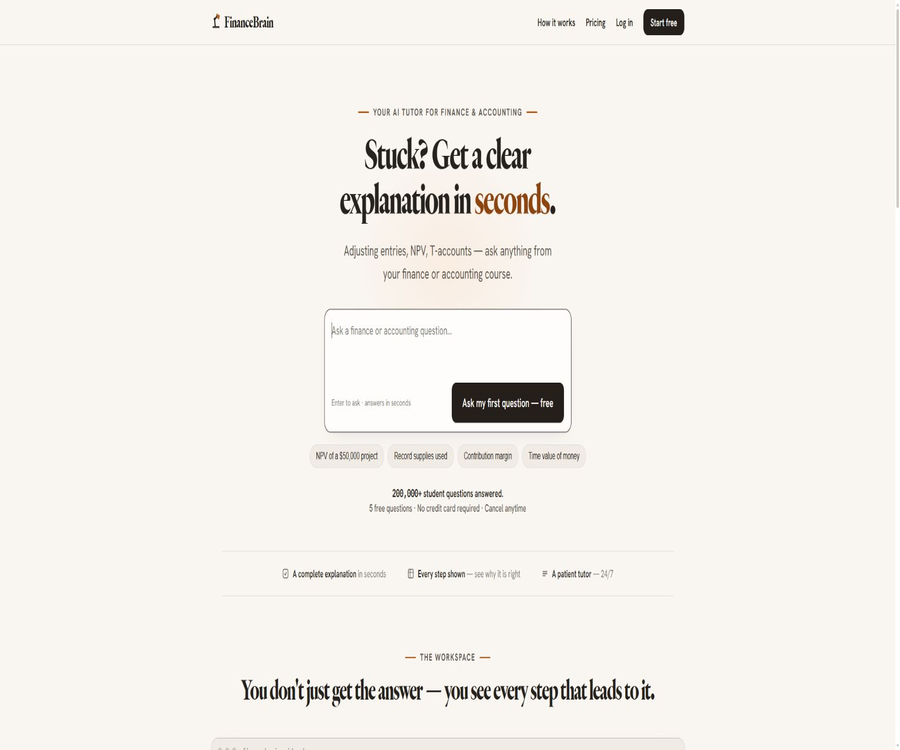
FinanceBrain
FinanceBrain: an intelligent tool specialized in AI-based processing of spreadsheet data.
Tags:AI table data processingA one-sentence summary
FinanceBrain is an AI-based tutoring tool for finance and accounting; it breaks down course topics into step-by-step instructions, formulas, and calculation processes, and allows students to ask questions about any parts they do not understand.
Tool Introduction
FinanceBrain is currently a service that offers online tutoring for adult students, covering financial and accounting topics such as accounting entries, net present value, and T-accounts. Users can ask questions in their own words or paste complete questions so that the system can provide step-by-step explanations for the answers.
The official website states that the platform has answered over 200,000 questions from students. Compared to solvers that provide the final answer directly, it places more emphasis on showing the reasoning process and allowing further questions and answers at each step.
It should be noted that the current positioning of this product differs from the descriptions of the company’s financial analysis provided in some earlier materials. This article is based on the information regarding financial accounting tutoring services as presented on the official website, pricing page, terms of service, and privacy policy as of August 22, 2026.
| Ability | Main function | Suitable for tasks |
|---|---|---|
| Natural language questioning | Understanding the course-related questions submitted by students | Concept explanation and approach to assignments |
| Solve step by step | Display formulas, calculations, and judgments in sequence. | NPV, interest, and journal entry exercises |
| Keep asking questions repeatedly | Further explanation for a specific step | Identify gaps and make corrections |
| Calculate summary | Display the intermediate values together. | Review the calculation process |
| Session history | Save the question and answer context | Continue with the previous learning discussion |
Main functions
Guidance on financial concepts
Users can ask questions regarding time value, capital budgeting, risk and return, discounting, and other course concepts. The system will attempt to provide explanations using formulas and examples, but it cannot guarantee coverage of all schools, textbooks, and curriculum systems.
Explanation of accounting issues
FinanceBrain can explain adjusting entries, accruals, T-accounts, and other accounting exercises. Different courses may vary in terms of account names, format, and rounding rules; it is necessary to check against the requirements specified in the textbook before submitting.
Complete solution analysis
Students can paste the entire question so that the system can identify the given conditions, objectives, and the calculation process. If a question is missing units, time periods, or key assumptions, it is necessary to provide those details first, rather than allowing the model to make guesses on its own.
Calculate step by step
The answers will present the discounting, aggregation, deductions, or accounting entries separately, making it easier to identify errors. For complex numbers, it is advisable to use a calculator, spreadsheet, or the answers provided in the course for further verification.
Ask follow-up questions regarding the steps
If a particular step is not clear, users can ask why a certain formula is used, why an account is debited, or where the numbers come from. Asking continuous questions is a better way to understand the process than repeatedly submitting the same question.
Learning workspace
The official website presents the information in such a format that explanations, calculations, and numerical summaries are all available in the same workspace. The privacy policy mentions spreadsheet workspaces, indicating that the platform may record relevant screen interactions; however, the public pages do not outline in detail the capabilities of these spreadsheets.
24/7 online access
The promotional offer for paid plans can be used 24/7, without being restricted by the hours of campus tutoring. The so-called unlimited number of queries is still subject to rules regarding fair individual use; scripts, robots, batch submissions, or shared accounts are not included within this limit.
Topics suitable for learning
| Theme type | Example task | Usage suggestions |
|---|---|---|
| Capital budgeting | Net Present Value, Discounted Cash Flows, and Project Evaluation | Verify the discount rate, period, and initial investment. |
| Interest calculation | Simple interest, compound interest, and accrued interest | Specify the annual interest rate and the months for interest calculation |
| Accounting entries | Adjusting journal entries, debit/credit directions, and account impacts | Follow the account name specified in the course. |
| T-account | Posting, balances, and debit/credit changes | Check the opening balance and direction. |
| Financial concepts | Comparison of formula meanings and methods | Understand it in conjunction with the definitions provided in the textbook. |
| Practice review | Check the steps that you have already completed. | Answer independently first, then compare. |
| Real investment or taxation | Not suitable as a basis for decision-making. | It is advisable to consult a licensed professional. |
Working principle
- Users create an account and enter or paste questions related to finance and accounting courses in the workspace.
- The system reads the question, the context of the current session, and any assumptions provided by the user.
- The content of the question is sent to the model service to generate a step-by-step explanation.
- The workspace displays the conclusions, formulas, intermediate values, and the sequence of derivations.
- If the user asks further questions about steps they do not understand, the system re-explains them based on the context.
- Students use textbooks, calculators, or teacher-provided materials to verify their results and organize their problem-solving process.
Usage tutorial
Solve a calculation problem
- Enter the questions in their entirety, preserving currency symbols, percentages, dates, and time period units.
- Indicate the targets that need to be calculated, such as net present value, interest, or the ending balance.
- The system is required to first list the known conditions and assumptions before starting the calculations.
- Carefully verify the formulas, symbols, discount sequence, rounding, and intermediate results.
- Ask separate questions about the steps that are unclear; do not just request the final answer again.
- Use the tools permitted by the course to redo the calculations independently, and rewrite the final results in terms of one’s own understanding.
Learn accounting entries
- Enter the business facts, date of occurrence, accounting period, and requirements of the task.
- Let the system first determine the assets, liabilities, equity, revenues, or expenses involved.
- Request an explanation for why each account was debited or credited, rather than just showing the journal entries.
- Check whether the account name is in line with the accounting standards outlined in the textbooks or those used locally.
- Practice again by changing the amount or period to confirm that you truly understand the rules.
- Comply with the school’s policies regarding the use of AI for tutoring, homework, and exams.
Which users are it suitable for
- Finance students: Practice capital budgeting, discounting of cash flows, and related calculations.
- Accounting students: Understand adjusting entries, account directions, and T-accounts.
- Beginners in business studies: Use natural language to supplement explanations provided in classes and textbooks.
- Adult students preparing for a test: Review the exercises and identify the steps they do not understand.
- Self-learners: Obtain structured instructions in the absence of immediate teacher assistance.
- Teachers or teaching assistants: They help to identify common comprehension difficulties that students may face, but they cannot replace course design.
Typical use cases
- After the class, re-understand the formula derivations that were not understood.
- Check the intermediate calculations for net present value, accrued interest, or account balance.
- Convert the complex descriptions in the textbook into simpler steps that are easier to understand.
- Ask for the reason behind the debit and credit directions in the entry.
- Use variant questions during exam preparation to check whether you have mastered the methods.
- Check the logic before submitting the assignment, but do not present AI-generated text as content that was created independently.
Product advantages
- Focusing on finance and accounting courses, the scope of issues is more defined than that of general chat tools.
- Displaying the calculation steps and intermediate values helps students identify errors on their own.
- It supports continuous follow-up questions, allowing for layered explanations around a single concept.
- The first 5 questions do not require a credit card, and they are suitable for testing the suitability of the course first.
- There is only one publicly available paid plan, and its price structure is relatively simple.
- Subscriptions can be canceled automatically through the account, without the need to use phone or email.
Usage restrictions and precautions
- AI responses may contain errors in formula selection, numbers, rounding, debit/credit direction, or concept explanation.
- The platform is a learning tool, and it is not a substitute for teachers, textbooks, or the official answers to lessons.
- One should not rely on these answers when making real investment, financial, tax, accounting, or legal decisions.
- The service is available only to users aged 18 and above; it is not suitable for minor students to register for.
- Schools may restrict the use of AI in assignments, quizzes, or exams, and students must adhere to rules regarding academic integrity.
- The Unlimited plan is intended for individual, normal learning purposes only; automatic scripts, batch submissions, or shared accounts are not allowed.
- Use involving continuous high intensity or content intended for resale may be subject to speed limits, suspension, or termination.
- The materials available are primarily intended for American students, and the course terminology and rules may not be suitable for other countries.
- There are no instructions regarding the upload of public documents, image-based question recognition, the use of textbooks, or teacher management.
- Questions and answers are saved and sent to various external services for processing; real financial data or customer confidential information should not be entered.
Price and subscription
The prices listed below were verified on August 22, 2026; the official website uses the US dollar as the unit of currency. FinanceBrain offers 5 free questions, and after that there is only one publicly available monthly subscription plan.
| Plan | Price | Billing cycle | Core rights and interests | Suitable for users |
|---|---|---|---|---|
| Free trial | $ | First 5 questions | No credit card is required; you can test the response method. | First-time users |
| Monthly subscription | 20 dollars | Automatic monthly renewal | Unlimited usage within individual fair use limits; access available 24/7. | Students who are continuously learning about finance and accounting |
| Annual plan | Not disclosed | Not provided | The official website does not list an annual pricing option. | Not applicable |
| Team or school program | Not disclosed | Not provided | There are no open seats or campus authorizations. | Contact for confirmation is required. |
Monthly subscriptions are automatically renewed at the price shown on the billing page; once canceled, they remain valid until the end of the current billing cycle. Except in cases of billing errors such as repeated charges, charges after cancellation, or loss of access, the fees already paid for that period are generally not refunded if one changes their mind.
Cancellation and refund
- Log in to your FinanceBrain account and open the billing settings.
- Go to the self-service billing page provided by Stripe.
- Confirm cancellation of the monthly subscription and record the current end date of access.
- Check the subsequent bills to ensure that no further charges are applied in the next period.
- In the event of duplicate charges, charges after cancellation, or inability to access the service during the payment period, please contact support using the account email address.
Supported platforms
| Platform | Currently supported | Explanation |
|---|---|---|
| Web browser | Support | Both the core workspace and subscriptions are accessed via a web page. |
| Windows | Use via a browser | No native desktop applications were found. |
| macOS | Use via a browser | No native desktop applications were found. |
| Linux | Use via a browser | Unpublished dedicated client |
| iOS | Mobile web pages may be accessible. | No official native applications were found. |
| Android | Mobile web pages may be accessible. | No official native applications were found. |
| Browser extensions | No findings were detected. | There are no official extension instructions. |
| APIs and SDKs | Not disclosed | Robots or scripts are not allowed to be used in bulk. |
Privacy and data processing
FinanceBrain collects names, email addresses, authentication identifiers, subscription status, questions, answers, usage patterns, device information, and advertising attribution data. The full number of credit cards is handled by Stripe, and the platform states that it does not store such complete card numbers itself.
Models and service providers
- The Clerk is responsible for registration, logging in, and session management.
- Stripe is responsible for payments, subscriptions, and the self-service billing portal.
- OpenAI receives the question along with the necessary context, which it uses to generate guidance answers in real time.
- Anthropic analyzes questions and answers on a bulk basis, using this for internal trend analysis and quality assessment.
- PostHog is used for product analysis and session replay.
- Google Ads receives ad click identifiers and hashed email addresses for conversion tracking.
- Vercel and Heroku offer hosting services, while MongoDB Atlas is used to store account details, chat records, and subscription information.
Session replay risks
PostHog’s session replay captures clicks, scrolling actions, and the content on the screen. Fields related to logging in, registration, account management, as well as email and password fields are obscured, but ordinary questions, other types of input, and the content of spreadsheet areas may not be hidden.
Therefore, do not enter real bank account details, tax IDs, student identification numbers, unpublished company financial statements, customer data, or course and work materials that are subject to confidentiality obligations. Even in the case of study questions, any information that can identify individuals or organizations should be removed.
Saving, deleting, and cross-border processing
- Account and conversation data are stored during the account’s active period, and remain for a reasonable time thereafter.
- Users can request access to, correction of, deletion of, and export of their personal information.
- Deletion requests are currently processed manually by the support team, and payment records required by law may remain retained.
- Product processing and data handling take place in the United States; data from users outside the country is transferred across borders.
- Visitors from the European Economic Area and the UK have analytics and advertising cookies disabled by default until they agree to it.
- Analysis and session replay in other regions may run by default.
- The platform states that it does not sell personal information for monetary gain, but the sharing of ad conversions may constitute data sharing under certain laws.
APIs, GitHub, and open source status
FinanceBrain does not provide public APIs, SDKs, or developer documentation. The terms of service explicitly exclude the use of robots, interface scraping, and bulk question submissions from individual, unlimited use; therefore, web services should not be accessed through automated means.
As of the time of verification, no official open-source product repository or license confirmed by FinanceBrain was found. The website, the tutorial workspace, and the server side should be classified as commercial and closed-source; financial code projects with the same name available on the Internet cannot be considered as the official source code.
Basic information
| Project | Content |
|---|---|
| Tool name | FinanceBrain |
| English name | Finance Brain |
| Current location | AI tutoring for finance and accounting courses |
| Primary users | Students aged 18 and above and self-learners |
| Core competencies | Step-by-step explanation, calculation display, and continuous questioning |
| Price pattern | The first 5 questions are free; thereafter, a charge of $20 per month applies. |
| Is registration required? | A account is required to use all the services. |
| Main markets | Primarily American students |
| Chinese support | The official website does not provide a clear commitment. |
| Main platforms | Web version |
| API | Not disclosed |
| Official SDK | No findings were detected. |
| Is it open source? | No |
| Model services | OpenAI generates the responses, while Anthropic is involved in bulk quality analysis. |
| Professional advice | No professional advice on investment, taxation, accounting, or law is provided. |
Recommendation score
Recommendation score: 4.0 / 5. FinanceBrain has a clear structure; its step-by-step explanations and follow-up questions are suitable for use in finance and accounting courses. The first 5 questions are available free of charge, which makes it easy to determine whether the tool is appropriate for the teaching materials being used.
The main drawbacks are that it is intended only for adults, there are no public mobile applications or APIs, and the session data is processed by multiple service providers. Students must also review their answers themselves and comply with the academic integrity rules of the course.
Frequently Asked Questions
What tool is FinanceBrain now?
It is currently an AI tutoring tool for finance and accounting courses, designed to help students understand questions, see the steps involved in solving them, and ask further queries. It is not a real-time investment analysis system intended for use by businesses.
Is FinanceBrain free?
The first 5 questions are available for free, and no credit card is required. After that, one must subscribe to a plan costing $20 per month in order to continue answering questions without any limits.
Is the so-called infinite problem truly unrestricted?
It is intended only for normal individual learning by a single user. Scripts, bots, batch submissions, shared accounts, resale, or excessive and continuous usage may result in speed restrictions, suspension, or termination of service.
Can it be canceled at any time?
It can be canceled manually through the account’s online billing settings. The cancellation takes effect at the end of the current billing cycle, and no phone calls, emails, or paper forms are required.
Can a subscription be refunded?
Refunds can be requested for billing errors such as repeated charges, charges after cancellation, or inability to access the service during the payment period. If one simply changes their mind, the fees for that period are usually not refunded, but access to the service remains available until the end of the cycle.
Are FinanceBrain’s answers accurate?
No guarantee can be provided. Presenting things step by step facilitates verification, but formulas, numbers, explanations, and the format of the lessons may still contain errors; it is therefore necessary to check them against textbooks, teacher materials, or independent calculations.
Can it be used to complete homework or exams?
Its intended use is to help understand concepts, review individual practice, and overcome difficulties in learning. Whether it can be used for specific assignments or exams depends on the school’s and teachers’ policies regarding the use of AI.
Can you provide investment or tax advice?
No. The platform is not a licensed investment advisor, accountant, tax advisor, or lawyer; real decision-making should be left to qualified professionals.
Can minors use it?
No. The current terms of service require users to be at least 18 years old.
Will the chat content be used to train the model?
The privacy policy states that the content submitted to OpenAI and Anthropic through commercial interfaces will, in accordance with their standard terms, not be used to train the general models of these providers. The conversations are still stored and may be used for internal quality analysis on the platform.
Will my questions be visible in the session replay?
It’s possible. Ordinary questions, as well as text in the workspace and data entered in spreadsheets, may not be hidden; therefore, real financial data, customer information, or other sensitive content should not be submitted.
Does FinanceBrain offer APIs or open-source code?
No public APIs, SDKs, or official open-source repositories were found. Automated scripts and batch submissions are also not part of the personal learning scope permitted under the subscription.
Summary
FinanceBrain is suitable for finance and accounting students over 18 years old who wish to understand formulas, journal entries, and calculation steps after class. The proper way to use it is to first think by oneself, then use it to clarify any difficulties and review the process, rather than simply copying the final answers.
The subscription rules are simple, but users should be aware of the provisions regarding automatic renewal, fair use, and the fact that refunds are generally not provided. When entering questions, one must also consider the privacy risks associated with saving conversations, processing external models, and replaying sessions.
Tools similar to FinanceBrain





 Guigong Network Security Registration No. 45132202000164